
Why This Matters for Enterprise AI
Every company is experimenting with AI. Most are still parked at the chatbot stage, where the system reacts, forgets the last turn, and does nothing but generate text. The organizations pulling ahead are building agentic systems instead: AI that takes initiative, picks up tools, coordinates with other systems, and gets better over time.
If your AI strategy stops at "we added a chat widget," you are already behind. The move from LLMs to agents is the move from a search bar to a workforce.
What Is an AI Agent?
An AI agent is a computational system that perceives its environment, makes decisions against a set of goals, and carries out actions to reach those goals on its own. Traditional software follows rigid, step-by-step instructions; an agent has room to choose its approach and take initiative.
Antonio Gulli describes an agentic AI as a smart assistant running a five-step loop:
- Get the mission: it receives a goal, such as "organize my schedule."
- Scan the scene: it pulls together what it needs from your inbox, your calendar, and wherever else the answer lives.
- Think it through: it works out a plan and weighs the best way in.
- Take action: it runs the plan by sending the invitations and booking the meetings, then updating the records.
- Learn and improve: it watches what happened and adjusts for next time.
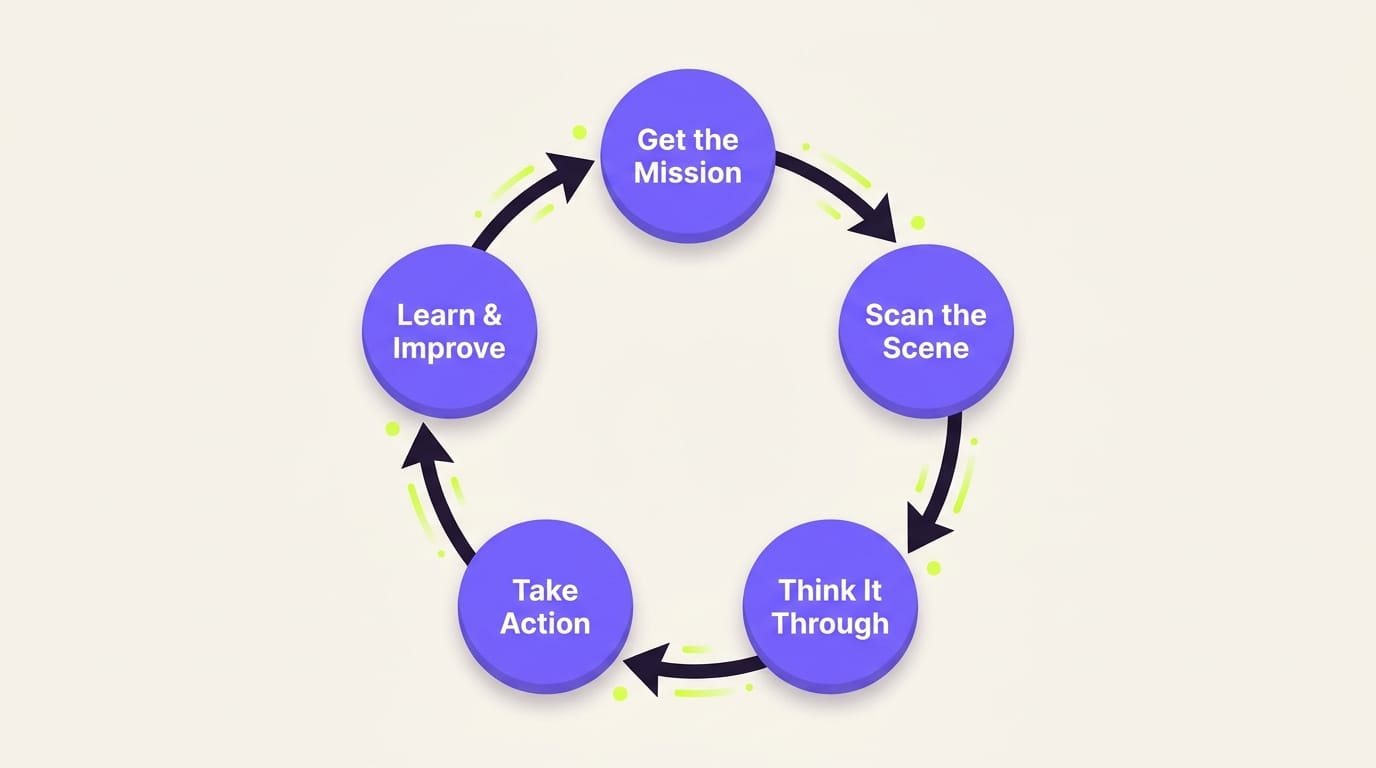
This loop is what separates an agent from a static model. The model generates text. The agent acts on the world and then checks whether the action worked.
The Four Levels of Agent Complexity
Not all agents are created equal. Gulli lays out a clear progression in what an AI system can do, across four levels.
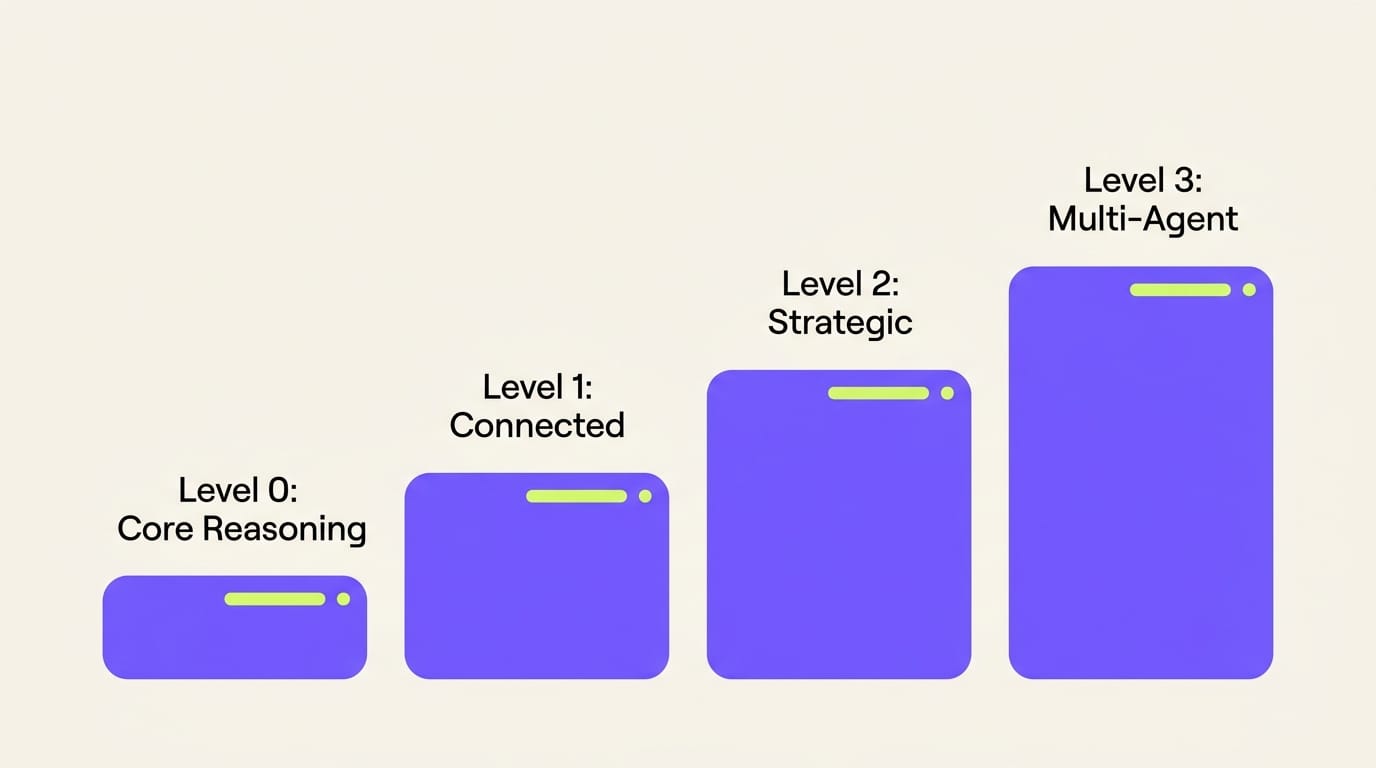
Level 0: The Core Reasoning Engine
At the most basic level, an LLM runs with no tools and no memory, and it has no way to touch its environment. It answers from pretrained knowledge alone. That makes it strong at explaining settled concepts and useless for anything that needs current information or a real-world action.
Enterprise reality: this is your basic chatbot. It can answer FAQs from its training data, but it cannot check your inventory, pull a customer record, or take any action that matters.
Level 1: The Connected Problem-Solver
Here the LLM becomes a working agent by connecting to external tools. It can run sequences of actions (searching the web, querying databases, calling APIs) to gather and process information that sits outside its training data.
Enterprise reality: a support agent that looks up order status, checks shipping APIs, and retrieves account information. It does things rather than only saying things.
Level 2: The Strategic Problem-Solver
At this level the agent can plan ahead, help before it is asked, and improve its own work. Two skills do the heavy lifting:
- Context engineering, which is the work of choosing and packaging the most relevant information for each step so the model is not buried in noise.
- Prompt engineering, which tunes the instructions you hand the model so it answers accurately.
A Level 2 agent does not wait for the request; it anticipates the need. Picture a travel assistant that reads your flight confirmation, pulls the key details, then updates your calendar and checks the weather where you are landing.
Enterprise reality: a coding agent that reads a bug report, opens the codebase, builds a focused context, then writes the patch and tests it before submitting, with a human stepping in only rarely.
Level 3: Collaborative Multi-Agent Systems
The most advanced level drops the idea of a single all-powerful agent. Instead, teams of specialized agents work together the way a human organization divides labor.
A product launch might run a "Project Manager" agent that coordinates a "Market Research" agent, a "Product Design" agent, and a "Marketing" agent. What holds it together is clean communication and shared information between them.
Enterprise reality: this is where whole business workflows get automated end to end, not by one monolithic system but by a coordinated team of specialists.
Five Hypotheses for the Future of Agents
Gulli outlines five hypotheses for where agentic AI is heading:
- The generalist agent: one agent that handles messy, open-ended, long-running goals reliably, or the inverse, a system composed from small expert agents instead of one scaled-up monolithic model.
- Deep personalization: partners that learn your patterns and anticipate what you need before you put it into words.
- Embodiment: agents leaving the screen to act in the physical world through robotics.
- The agent-driven economy: autonomous agents acting as economic players in their own right, running storefronts, managing supply chains, and moving prices in real time.
- Metamorphic multi-agent systems: goal-driven systems that rewrite their own agent topology on the fly, spinning up, cloning, or retiring agents to better hit the objective they were given.
Key Takeaways
- An AI agent perceives its environment, then decides, acts, and learns from the result. It does more than generate text.
- The four levels of complexity run from a bare LLM up to collaborative multi-agent systems.
- Context engineering, which is curating what information the agent works with, matters as much as the model itself.
- The direction of travel is self-organizing teams of specialized agents rather than one monolithic system.
- Enterprises that invest in agentic architecture now hold a structural advantage over those still shipping chatbots.