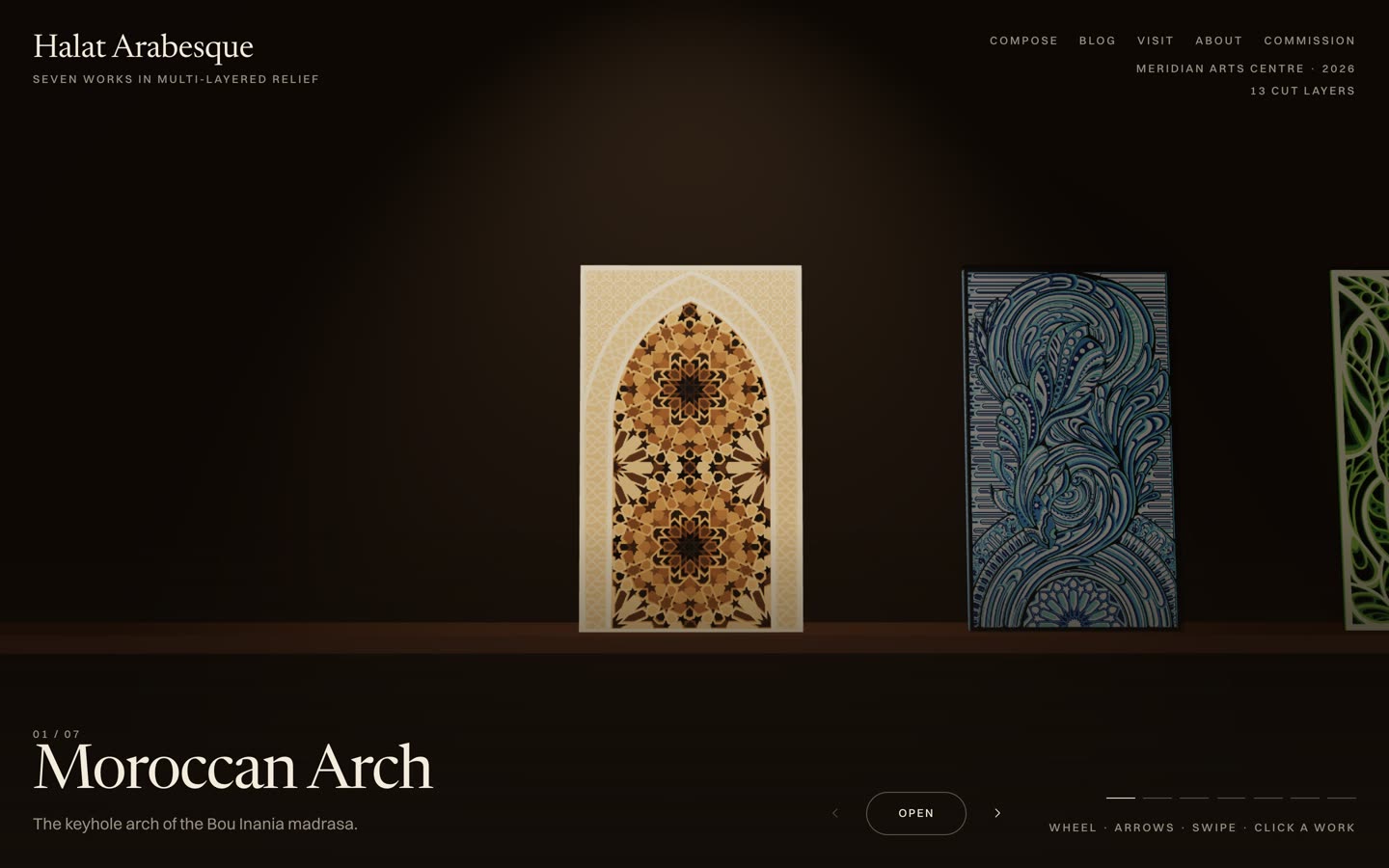
Halat Arabesque is Mahmoud's first solo exhibit: seven works in multi-layered relief, shown at the Meridian Arts Centre during Toronto Doors Open. The pieces are laser-cut cardboard, painted and stacked twenty-plus layers deep, framed in hardwood, and drawn from centuries of Islamic geometric design — zellige tile, muqarnas, the rosettes carved into Moroccan madrasa doors.
Relief sculpture is difficult to sell on a screen. Depth is the whole point of the work and it is the first thing a photograph flattens, which is why so much of this kind of art ends up looking like a print in a white gallery grid. The site solves it the way a gallery does: a dark room, a spotlit shelf, and one piece at a time. You move through the seven with the wheel, the arrow keys, or a swipe, and the shadow between layers does the work the caption otherwise has to.
The site also carries the making. Each piece runs from a parametric sketch through the laser cutter, then hand-cleaning every layer, priming, painting, building the frame, and assembling the stack — about seventeen hours of hand-work per piece, documented rather than implied.
The piece that earns the most time on the page is the composer: a tool that lets a visitor build their own palette across the layers in about a minute. It turns a gallery visit into something you do rather than scroll, and it is the reason people come back to the site between shows.