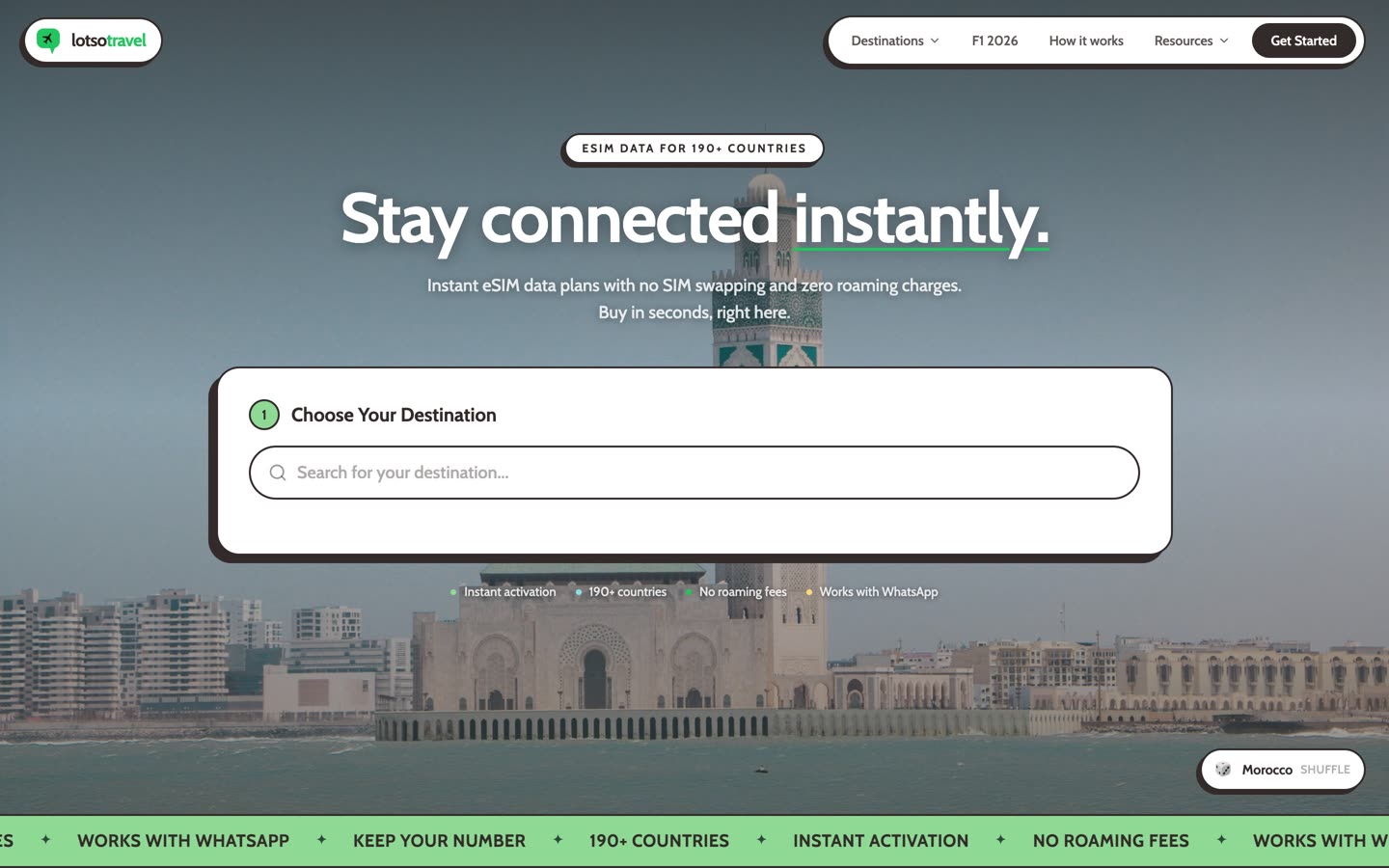
Lotso Travel is an eSIM store: pick a country, buy a data plan, and you're connected abroad in under 30 seconds, with no physical SIM, no roaming bill, and no airport scramble. It covers 195 countries. The product was already good before any of the SEO work started, and that matters, because the traffic we sent it had somewhere to land.
The checkout is the part that earns its keep. Country selection is one step. Plans compare side by side with no hidden fees or mystery tiers. The whole flow is built for the phone, because that's where people buy an eSIM, often standing at a departure gate. Stripe runs the payment with Apple Pay and Google Pay for a one-tap purchase, and the eSIM provisioning APIs deliver the profile by QR code within seconds of payment. Top-up reminders bring people back when their plan runs low.
The problem was visibility, not the product. Organic search brought in almost nobody who didn't already know the name "lotsotravel." The generic terms, "buy travel eSIM," "Europe eSIM," were locked up by Airalo, Saily, and other well-funded competitors, and Lotso had no blog to catch anyone still in the research stage. So we stopped fighting on terms we couldn't win.
The play was pain-point SEO aimed at one frustrated audience: Canadians staring at a roaming charge. We launched the Lotsotravel blog and pointed it at the exact comparisons those travellers type, expensive Canadian carrier plans against the eSIM alternative. Every post was generated through our content pipeline and then read by a person for accuracy and tone before it shipped, which let us publish at volume without the quality sliding.
Within three months the blog was ranking at the top of Google for high-intent long-tail queries, sitting just behind the official Rogers and Telus pages for terms like "rogers roam like home vs esim," "telus easy roam vs esim," and "rogers travel pass vs esim cost." Landing one slot under the carrier on a "vs esim" search means catching the buyer at the moment of bill shock, and the 30-second checkout closes the gap between that frustration and a purchase. The takeaway holds up past this one client: the smaller budget can win the search when it picks the fight where the big spenders aren't looking and pairs it with a checkout built to convert.