
On May 19, 2026, Elizabeth Reid stood on stage at Shoreline Amphitheatre and said something that should have made every small-business owner in the world stop scrolling: "Google Search is AI." Not "Google Search uses AI." Not "Google Search is enhanced by AI." Is.
I watched the keynote live. I read every announcement post the following day. Then I read every credible third-party analysis that landed in the following week. I want to tell you what changed, why it matters more than AI Overviews did, and what you should do about it before your competitors figure it out.
This is the second pillar of our Google SEO Bible. The first pillar, The 2026 Google SEO Reality, is what Google's own documentation has said for years. This one is everything that broke that documentation in 90 minutes.
The announcement, in 90 seconds
Reid is VP of Search. She has been at Google since before AI Overviews existed, and she gave the keynote that introduced them in 2024. She is not a hype merchant. When she stood up on May 19 and announced the largest set of Search changes since AI Overviews launched, she did it with the kind of restraint that Google reserves for things they are confident will stick.
Here is what shipped that day:
- Gemini 3.5 Flash became the default model inside AI Mode, in every market at once.
- The search box itself was redesigned for the first time in 25+ years. It now accepts text, images, files, videos, and Chrome tabs as inputs.
- Conversational follow-ups landed inside AI Overviews, so the result stays open and the context persists across your next question.
- Personal Intelligence, the layer that connects your Gmail, Photos, and (soon) Calendar to AI Mode, expanded to roughly 200 countries and 98 languages on the free tier, with no subscription required.
And here is what's coming this summer:
- Information Agents: background programs that monitor blogs, news, social, finance, shopping, and sports for criteria you set, then report back and take action.
- Agentic booking and calling: Google places phone calls to local businesses on your behalf for things like home repair, beauty, and pet care.
- Generative UI: Search assembles interactive dashboards, simulations, and visualizations on the fly. A query about watch mechanisms returns an animated diagram. A query about astrophysics returns an interactive visualization. There is no pre-existing page being ranked. The interface is generated.
- Universal Commerce Protocol: cross-merchant agentic checkout, co-developed with Shopify, Etsy, Wayfair, Target, and Walmart.
A few hard numbers from Google's own data: AI Mode crossed 1 billion monthly users one year after launch. Queries doubled every quarter since the start. AI Mode queries are 3x longer than traditional searches. Voice plus image inputs are now more than 1 in 6 U.S. searches.
That is the announcement. Now let me explain why it's bigger than AI Overviews was.
Why this is bigger than AI Overviews
AI Overviews was already huge. It launched in 2024, hit 2.5 billion monthly active users (MAU, the count of distinct people using it in a month) by mid-2026, and changed publisher economics on a scale that is still being measured. Independent data on what it did to click-through rates (CTR, the share of people who actually click a result after seeing it) is brutal. I'll come back to those numbers.
But AI Overviews was a feature added on top of Search. The 10 blue links still showed up below it. You could ignore AI Overviews if you wanted to. Most users didn't, but you could.
I/O 2026 isn't another feature bolted on top of Search; it rebuilds the thing underneath. Five things changed at once:
The query changed. Search used to be 2-3 words. AI Mode queries average 3x longer: full sentences, multi-clause, conversational. You are now optimizing for the question your customer would actually ask out loud, not the keyword phrase your SEO consultant put in a spreadsheet.
The input changed. The search box now accepts images, files, videos, and Chrome tabs. People drop a screenshot in and ask a question about it. They drop a PDF in. They drop a YouTube video in. The first 25 years of SEO assumed a text query. That assumption is dead.
The output changed. The result is no longer a list of links. It is a synthesized answer with conversational follow-ups, or a generated interactive interface, or a dashboard, or a phone call placed on your behalf, or a Universal Cart that completes purchase across five merchants. The link to your page is one component of a larger composite.
The user changed. It used to be a human at a keyboard. It is now sometimes a human, sometimes a delegated agent (Chrome auto-browse, Gemini Spark) acting on the human's behalf. The traffic that hits your site may be one or the other. Most analytics setups can't tell.
The ranking layer changed. Personal Intelligence means each user has a private per-user signal layer that crawlers cannot see. A user with a Delta confirmation email in Gmail gets different results for "things to do in Lisbon" than a user without one, which means there is no single ranking anymore.
That's why this is bigger: AI Overviews changed a feature, while I/O 2026 changed the substrate underneath it.
The new surfaces, what you're now optimizing for
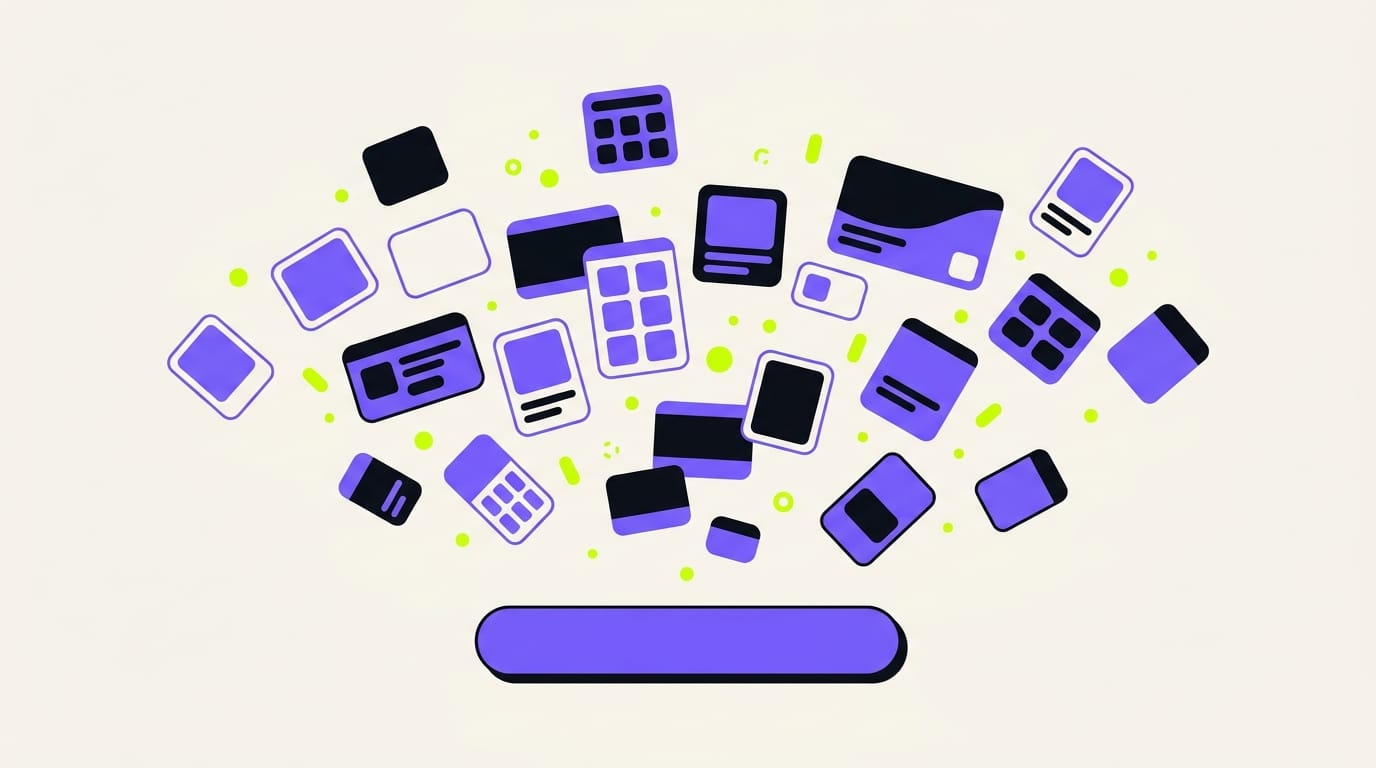
Search has fragmented. There is no "the SERP" (the search engine results page, the screen of results you get after a query) anymore. There are now at least nine distinct surfaces a user can land on or be served by, each with its own optimization rules:
- Classic blue-links SERP: still alive, still ranking, still where transactional and local intent gets served well
- AI Overview: the synthesized answer block at the top of many queries
- AI Mode chat: the conversational interface, 1B+ MAU, queries 3x longer
- Ask YouTube: vertical AI search inside YouTube, with timestamp jumps
- Ask Maps: conversational interface inside Google Maps
- Information Agents: background monitoring, summer 2026 launch
- Generative UI: on-the-fly assembled dashboards and interactive visualizations
- Personal Intelligence / Daily Brief: pre-empted, per-user briefings
- Universal Cart: cross-merchant agentic commerce
Your old SEO scorecard measured one thing: classic SERP rank. Your new scorecard measures nine things. You can optimize for some of these surfaces, get selected for others, and a few haven't shipped yet but will hit your traffic before year-end.
> The single most useful reframe: Search is no longer a place users go to find information. Search is now a layer that finds information for users, sometimes without their explicit query. The "non-query" is now a traffic source.
The data: citation-as-position-one
This is the part of the talk I had to read three times before it sank in. I'll cover the data in depth in Citation is the new position one, but here is the headline.
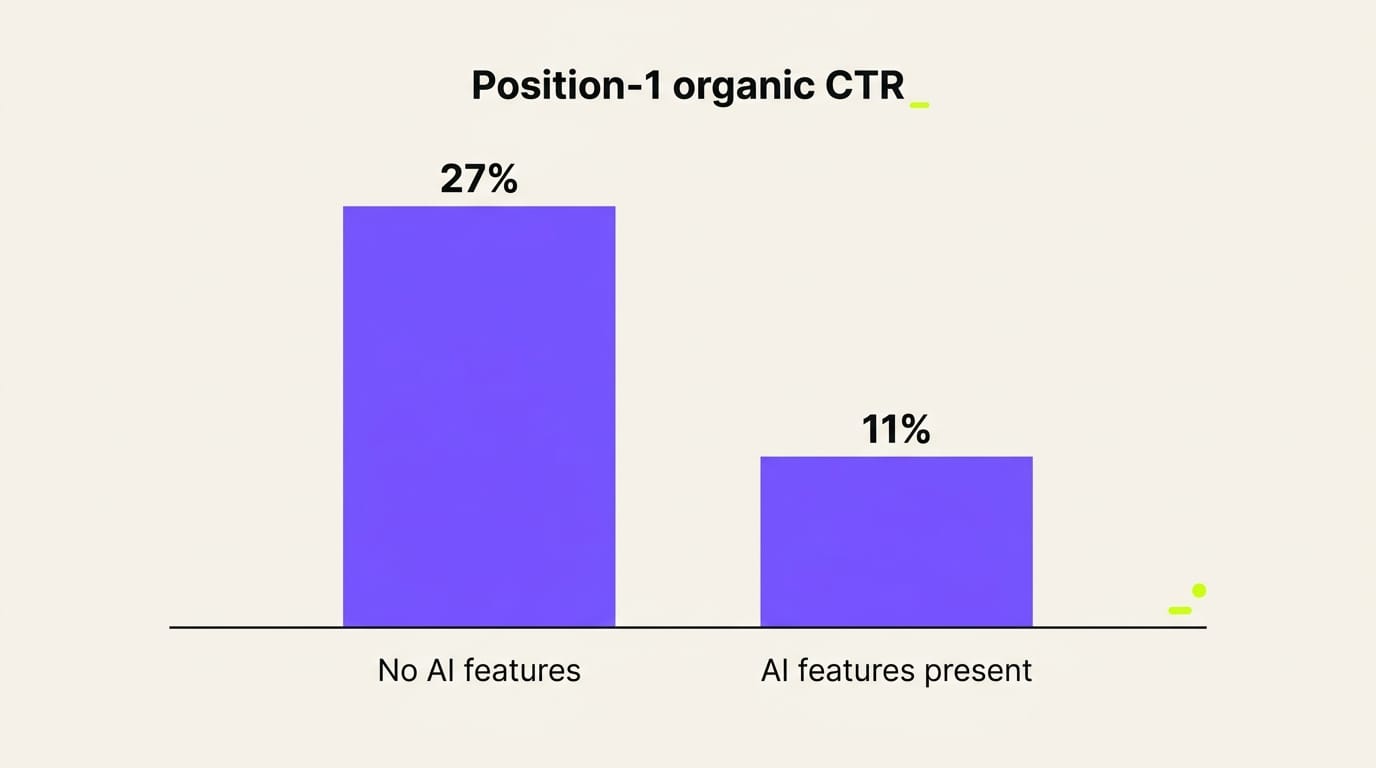
Position-1 organic click-through rate on queries where AI features appear has collapsed from 27% to 11% (SISTRIX, March 2026). On a 68,000-query sample, Pew Research measured a 46.7% CTR decline when AI Overviews are present (8% with, 15% without). DMG Media's UK Competition and Markets Authority filing put the worst case at 87-89% desktop and mobile CTR loss.
But here is the part nobody is shouting about: brands that get cited inside the AI Overview see +35% more organic clicks and +91% more paid clicks than uncited competitors on the same query (Digital Applied, March 2026). Amsive measured branded-search CTR up +18%.
The math is plain. If you are not cited inside the AI answer, you lose roughly half of what you used to get from rank #1. If you are cited, you outperform what rank #1 used to deliver, because the AI Overview pre-qualifies the visitor.
That is what we mean by "citation is the new position one": it isn't a tagline, it is the operational truth, and most of the SEO checklists circulating right now are still measuring the wrong number.
The protocols you've never heard of
Three new standards landed at I/O 2026 that will be shaping the next two years of work. None of them have made it into mainstream SEO coverage yet.
WebMCP (navigator.modelContext). In plain terms, it is a way for your website to hand AI agents a menu of buttons they can press without a human clicking. A Chrome-proposed standard, currently in Chrome 149 origin trial, it lets your site declare structured tools that AI agents can invoke directly: a searchProducts({query, maxPrice}) function, or a bookAppointment({date, service}) function, or a getInventory({sku}) function. When an agent is choosing which site to drive a user to, the site with WebMCP declarations wins. The site without them gets skipped. This is the standard nobody is talking about.
Universal Commerce Protocol (ucp.dev). In plain terms, it is a shared checkout language so an AI agent can buy across several stores in one go. Co-developed with Shopify, Etsy, Wayfair, Target, Walmart, it standardizes how AI agents complete checkout across merchants. Critical for any commerce site. If you sell things online and you are not integrated with UCP partners by Q4 2026, you will be invisible inside Universal Cart.
SynthID + C2PA Content Credentials. In plain terms, these are a tamper-evident "nutrition label" stamped into an image so Search and Chrome can tell where it came from. Provenance verification is baked into Search and Chrome, and partners include OpenAI, Nvidia, Eleven Labs. If you publish AI-assisted images, attaching C2PA credentials is the difference between "labeled origin" and "labeled AI slop" in the user's view.
I'll cover each of these in their own posts: WebMCP and Universal Commerce Protocol.
The agent-traffic class
This one is the sleeper. Chrome auto-browse and Gemini Spark mean AI agents will increasingly hit your site acting on behalf of human users: completing forms, navigating multi-step flows, executing purchases. They will not use the Googlebot user agent. They will look like a normal Chrome browser, because they are.
Publishers that block "non-human" traffic with overzealous Cloudflare or Akamai bot rules are about to start blocking their own customers' delegated agents. We are about to enter an era where the question "is this traffic a bot?" stops being a binary.
The right move: stop blocking by user agent. Start segmenting by behavior. Your analytics needs a custom dimension that distinguishes human visits from agent-on-behalf-of-human visits. Otherwise your conversion rate charts will start moving for reasons your team cannot explain.
More on this in The new traffic class: agents acting on behalf of users.
Personal Intelligence: the shadow ranking layer
Personal Intelligence connects your Gmail, Photos, and Calendar to AI Mode once the user opts in. From that moment forward, the ranking the user sees is partially determined by data the public web cannot crawl.
A flight confirmation to Lisbon sitting in Gmail surfaces different sources for "best restaurants in Lisbon," receipts from a specific retailer push that retailer higher in shopping queries, and a calendar event for "yoga class Saturday" weights fitness content up.
There is no public crawl that captures this. Rank tracking, as a discipline, is becoming partial fiction. We have to start measuring different things: branded search share, direct traffic, email list size, the strength of your entity presence across the web. Personal Intelligence: the ranking layer crawlers can't see gets into this in depth.
What to actually do about it
If you are a small-business owner reading this and feeling a little nauseous, fair. Let me give you the operational checklist. Three timeframes.
This week
Audit your homepage and your top five service pages. For each one, find the single declarative sentence that answers the page's main question, and check that it appears in the first 100 words. If it doesn't, move it. AI extractors lift cleanly from the first 100 words. If your answer is buried in paragraph six, you lose the citation.
Check that your business is fully claimed and current on Google Business Profile (relevant for dentists, contractors, restaurants, lawyers, accountants, real estate teams, and any other local business). Ask Maps depends on it.
Set up branded-search tracking in Search Console. The +18% branded-CTR lift means brand equity now compounds into search visibility in a way it didn't before.
This month
Rewrite your top-converting pages so every H2 reads like a question your customer would actually ask. "Why our deck cost $30,000" beats "Pricing." "How long does an extraction take?" beats "Extractions."
Add a visible last-modified date to every page that contains factual claims, because AI systems weight freshness.
Audit your bot-blocking and WAF (web application firewall, the filter that decides which automated visitors to let through) rules. Stop blocking by user agent. Block by behavior.
If you sell things online, start the conversation with your platform about Universal Commerce Protocol integration. Shopify users get this for free. Custom-built carts have work to do.
This year
Build out one piece of original, citable research per quarter. AI systems gravitate toward sources with stable factual units: specific numbers, attributed quotes, named entities. Commodity content is the first thing to get summarized away. We've watched this play out across categories: lifestyle blogs and listicle sites took the worst of it; sites with proprietary data and first-hand expertise took less of a hit.
Build a direct-audience channel that doesn't depend on Google, whether that's an email list, an SMS list, a podcast, a newsletter, or an owned community. If a single algorithmic change at Google can erase your business, you don't have a business, you have a tenancy.
Start treating your structured data, your schema, your entity references, your bylines, your dates, and your facts as if an AI parser will read them, because before long one will.
The honest version
I think Google's framing of I/O 2026 is mostly accurate and partially wishful. The accurate part: Search is being rebuilt as an answer layer, an agent layer, and a commerce layer simultaneously. The wishful part: Google insists publisher traffic is "high quality" and that SEO fundamentals "still apply unchanged." The independent data from Pew, SISTRIX, DMG Media, and Chegg's quarterly filings tells a more complicated story.
Both can be true at once: the fundamentals still apply, and they are also no longer sufficient on their own. Publishers and small businesses that win in this era will be the ones who do the fundamentals plus a citation-engineering layer, plus a direct-audience moat, plus a brand-presence investment that pays off in the +18% branded-CTR territory.
This is the second pillar of the Google SEO Bible. The spokes that follow each cover one piece of what just changed in depth, with the data, the protocols, and the operational steps for each. Start with Citation is the new position one and How to actually get cited in an AI Overview. Those two together will do more for your traffic than anything else you read this month.
Sources
- A new era for AI Search (Elizabeth Reid, Google, May 19, 2026)
- Welcome to the agentic Gemini era (Sundar Pichai, Google, May 19, 2026)
- How AI Mode is changing the way people search (Shivani Mohan, Google, May 19, 2026)
- Optimizing for generative AI search (Google Search Central, May 2026)
- The search changes SEOs did not expect (Luis Rijo, PPC Land)
- AI Overviews impact on publishers (Matt G. Southern, Search Engine Journal)
- The new AI search update (Tanner Medina, Launchcodex)
- 2026 Publisher's Guide to AI Overviews (Robert Portillo, 12AM Agency)