
I read every page of Google's Search Central documentation. Twice.
I did it because every client conversation about SEO has become a debate. One side quotes a Twitter thread, the other quotes a YouTube guru, and almost no one quotes Google.
So I went to the source. 287 markdown files. Every doc Google publishes about Search, every Search Off the Record podcast transcript, every Search Central blog post, then the May 19, 2026 I/O announcements on top of that.
What I found is that most of what SEO Twitter says is wrong, and not in a subtle way. Google has been telling everyone in plain English on developers.google.com for years.
This is the first post in a 17-piece series we're calling The Google SEO Bible. The goal is simple: tell you what Google says, with citations, so you can stop guessing.

What Google's own docs say, and what most SEOs get wrong.
The four layers
Google publishes its own architecture diagram. There are four layers, and every SEO question fits inside one of them. Get the layer wrong and you'll fix the wrong thing for months.
Crawl, index, rank, appear.
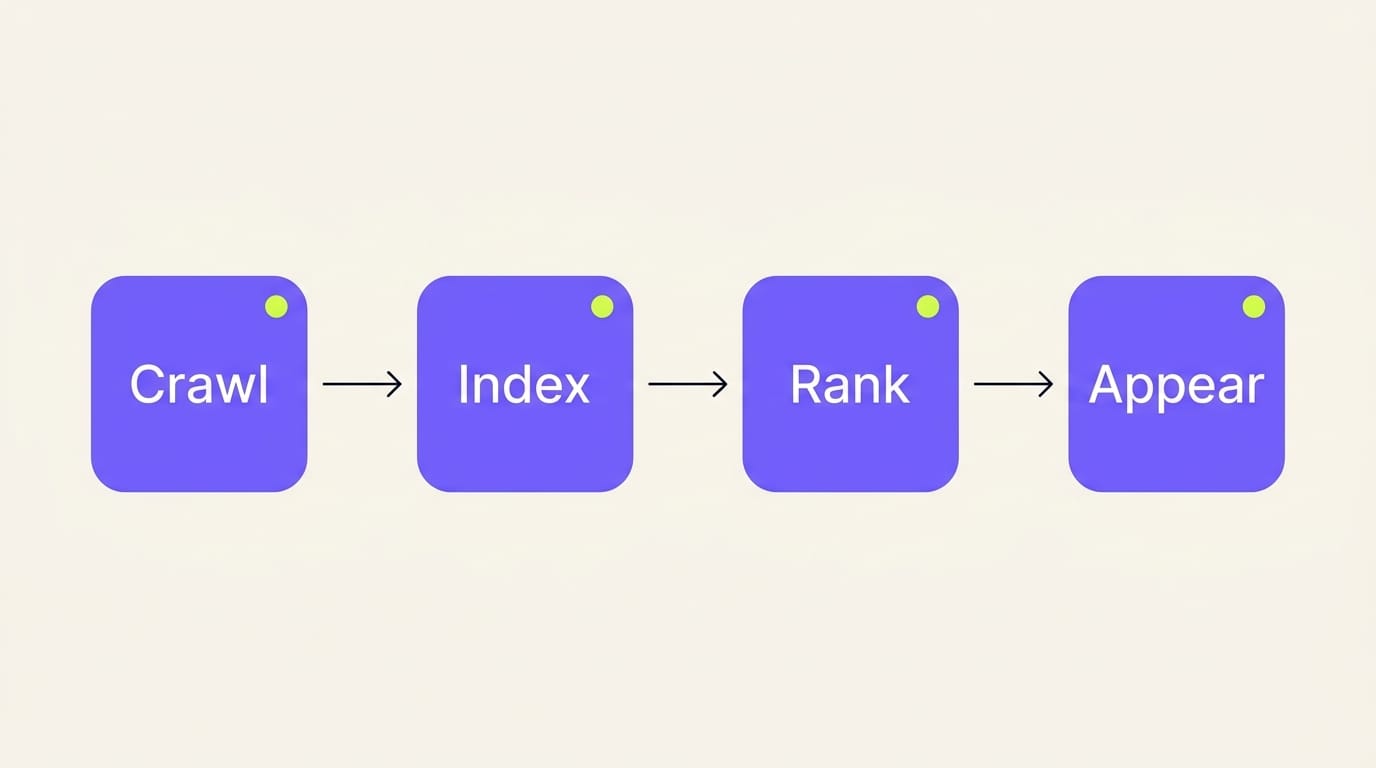
Per Google's In-Depth Guide to How Google Search Works, Search runs in three core stages (crawling, indexing, and serving results) and not all pages make it through each stage. I add a fourth layer because what happens after the result is chosen matters now more than ever: how your page appears in snippets, rich results, AI Overviews, and AI Mode.
Crawl is discovery: Googlebot finds your URL, fetches it, runs the JavaScript in a headless Chrome, and decides whether the bytes were worth pulling. There are byte limits at this layer that most sites have never measured, and most of what SEOs blame on "indexing" is a crawl problem. We cover the worst offender, the 2MB rule, in a dedicated spoke.
Index is storage: Google groups your page with duplicates, picks one canonical URL out of the cluster, and stores signals about it in a massive database. Per Google: "Indexing isn't guaranteed; not every page that Google processes will be indexed." If your page never crossed into the index, none of your ranking work matters. We cover what determines that step in Canonicalization: stop fighting Google's canonical picker and The crawl budget myth.
Rank is selection: when a user types a query, Google's ranking systems pull from the index and order results. The ranking systems are a portfolio (RankBrain, BERT, neural matching, passage ranking, link analysis, the reviews system, freshness systems, the helpful content system that moved into core in March 2024, and more) so there is no single "the algorithm." Per Google's Ranking Systems Guide, these systems work at the page level, with site-wide signals contributing.
Appear is presentation, where your blue link becomes one of dozens of possible surfaces: featured snippets, image packs, knowledge panels, AI Overviews, AI Mode cards. The rules for showing up in each surface are different, and structured data is what makes specific surfaces eligible. We cover the full inventory in Every structured data type Google still rewards in 2026.
The layers matter for debugging. When a client says "my SEO is broken," the first question is always which layer, because you don't fix a ranking problem with a crawl tool and you don't fix an appearance problem by writing more content.
Five myths Google's own docs contradict
These are the five most expensive SEO myths I run into. Every one is debunked in plain text on developers.google.com or by a named Googler on the Search Off the Record podcast, and businesses lose budget and rankings acting on them.
Myth 1: E-E-A-T is a ranking signal
It isn't. Google says so directly.
The Search Engine Optimization Starter Guide, under "Things we believe you shouldn't focus on," includes the section "Thinking E-E-A-T is a ranking factor." The body of that section is three words: "No, it's not." With a link.
The link goes to Creating Helpful, Reliable, People-First Content, which spells it out: E-E-A-T (Experience, Expertise, Authoritativeness, Trustworthiness) is a mnemonic from the Search Quality Rater Guidelines. Quality raters use it, and Google uses rater data the way a restaurant uses feedback cards. The data does not flow into the ranking algorithm.
Per Danny Sullivan on Search Off the Record episode 63, the practical implication is this: don't bolt a doctor byline onto a USB microphone product page because you read a thread about E-E-A-T. Demonstrate expertise where users would expect it. We go deeper in E-E-A-T isn't a ranking signal.
Myth 2: FAQ rich results still work
They don't, not for almost anyone.
Google sunset broad FAQ rich result eligibility in August 2023 and limited them to authoritative government and health sites. The deprecation continued. By the May 7, 2026 cleanup pass, the eligibility windows for FAQ schema on general sites are effectively closed. Other rich result types Google has retired: How-to (sunset on desktop in September 2023), Event "carousel" variants, and a handful of niche markups consolidated under simpler surfaces in 2025.
The lesson is not "don't add FAQ schema." The lesson is that the markup gets your content discoverable for AI Mode and AI Overviews, not a blue stars badge in the SERP. That's a different goal. We cover what is still rewarded in Every structured data type Google still rewards in 2026.
Myth 3: Meta keywords help
They don't. Google was explicit about this in 2009 and has repeated it every year since.
From the SEO Starter Guide, under "Things we believe you shouldn't focus on": "Google Search doesn't use the keywords meta tag." That is the whole sentence. The link is to a 2009 Google Search blog post titled "Google does not use the keywords meta tag."
Sixteen years of consistent messaging and you'll still find SEO templates with a meta keywords field. Remove it from your CMS template. It's wasted bytes.
Myth 4: The Indexing API speeds up normal pages
It doesn't. It works for two narrow content types only.
Google's Indexing API exists. It is real, and you can submit URLs to it. For most pages, nothing happens.
Per Google's documentation, the Indexing API supports exactly two structured data types in production: JobPosting and BroadcastEvent (for embedded livestream videos). Submit a normal blog post, product page, or service page and the API accepts it, then Google quietly ignores it.
The path to faster indexing for normal pages is unchanged: submit a clean sitemap, fix server speed, fix internal links, fix the quality signals that determine whether Google bothers to come back. Per the SOTR podcast episode 64 (The effect of quality on Search), "quality is the biggest driver for most of the indexing and crawling decisions that we make."
Myth 5: Googlebot reads your whole 10MB page
It doesn't. The cap is much tighter than that.
Per Gary Illyes's March 31, 2026 Inside Googlebot blog post, Googlebot fetches up to 2 MB of HTML per URL. PDFs get 64 MB, and other Google crawlers default to 15 MB. Content past the limit is silently truncated, never rendered and never indexed.
> Googlebot's per-URL fetch limit for Search rendering is 2 MB of HTML, including HTTP response headers. Anything past 2 MB is silently truncated. Per Google Search Central, March 31, 2026.
The 2 MB cap includes HTTP response headers. It explains every "Google isn't seeing my structured data" ticket I've debugged for the last six months. We cover the practical implications in The 2MB rule.
What actually ranks
The myths above are easy to debunk because Google publishes the answers. What ranks is harder to pin down because it's a system, not a checklist, though there is a defensible answer if you read enough of Google's own writing.
Four pillars, no shortcuts.
1. Technical fundamentals that don't fight the four layers. A clean crawl path means robots.txt that works, no accidental crawl traps, no JS framework that hides links from rendering, and a server that doesn't time out under crawl pressure. A clean index path means consistent canonicals, no duplicate spirals, and no soft 404s in single-page apps. Per Danny Sullivan on SOTR episode 63: "If you have great technical SEO, you'll rank number one. No, you should have good technical SEO." Necessary, not sufficient.
2. Content depth that holds up to the "Who, How, Why" test. Creating Helpful Content asks three things: who created it (is there a clear author with credibility for the topic?), how it was made (was a product tested, was AI used, were sources cited?), and why it exists (to help a real reader, or to harvest search traffic?). The test isn't whether you wrote 2,000 words, because there is no Google word count. Per the Helpful Content guidance, "the length of the content alone doesn't matter for ranking purposes." What matters is whether a thoughtful reader would find the page useful.
3. Structured data done correctly. Schema.org markup is no longer just about rich result badges. It's how AI crawlers, AI Mode, and AI Overviews extract clean facts from your page. The right types (Organization, Article or BlogPosting or TechArticle, Product, LocalBusiness, FAQPage where eligible, BreadcrumbList, Person) give Google a machine-readable summary of your page. Wrong types or invalid markup get silently ignored. We covered the studio's view of this in our structured data guide.
4. Page experience as a mindset, not a CWV chase. Core Web Vitals (LCP, INP, CLS) are real signals, but per Danny Sullivan on SOTR episode 63: "Don't expect to chase Core Web Vitals to 8000% and rank automatically." Page experience is a broad judgment that includes intrusive interstitials, ad density, mobile usability, page weight, and JavaScript bloat. We cover it in Core Web Vitals in 2026: what actually changes your score.
The dishonest framing is "Google's algorithm is a black box." The honest framing is that Google publishes the architecture, the signals are listed, the retired systems are named, and the myths are debunked in the docs themselves. What's left ambiguous is the specific weighting, because Google deliberately doesn't publish weights and would be insane to.
Per Gary Illyes on SOTR episode 64: "Quality, that's the biggest driver for most of the indexing and crawling decisions that we make." That is the through-line: quality is the unifier.
How updates actually work
This last piece is where most SEO panic lives, so it matters.
Google runs core updates several times a year. They are broad reweightings of the ranking systems, not punishments aimed at specific sites. Per Google's Core Updates guidance, "most sites don't need to worry about core updates and may not even realize one has happened."
If your traffic drops after a documented update:
- Wait at least a week after the rollout completes
- Compare a week before to a week after, not day to day
- Look at the size of the drop. Position 2 to position 4 doesn't warrant a panic rewrite
- Re-read the guidance for whichever system the update touched (creating helpful content, reviews, page experience)
- If you decide changes are needed, make them sustainable, not quick fixes
Per the Search Off the Record podcast, the Google view of post-update behavior is consistent: do not reverse-engineer, re-align with the published guidance. Updates that reward you don't need a response, and updates that hurt you are a signal to re-read, not a signal to delete content.
The bigger trap is reacting to "mystery updates," every Twitter spike that someone calls an update. Most of them aren't real. Google publishes notable updates on the Search Status Dashboard, so if you didn't see a notice there, that ranking dip was probably a different cause.
And then I/O 2026 changed everything
Everything above is the steady-state Google Search reality: the four layers, the debunked myths, the four pillars, and reasonable patience after updates.
Then May 19, 2026 happened.
At Google I/O 2026, Sundar Pichai introduced AI Mode as the default surface for a growing percentage of US queries. Generative UI rendered inside Search results. Ask YouTube, Ask Maps, and Information Agents shipped. WebMCP (a new protocol for agent-to-site communication) was announced. Universal Commerce Protocol let agents check out on your behalf. Personal Intelligence brought Gmail, Calendar, and Drive context into ranking signals that crawlers can't see. Chrome started auto-browsing on behalf of users.
The four layers still exist and quality still wins. But how your page appears, and to whom, exploded into a new surface area. The user is no longer always a human.
We cover what changed and what to do about it in the second pillar of this series: What Google I/O 2026 Just Changed.
The pattern is unchanged, in that Google rewards quality, punishes manipulation, and publishes the rules. What's new is that 2026 is the year AI surfaces and agent traffic stopped being theoretical, and this Bible series builds out the rest post by post: eight foundation spokes under this pillar, seven I/O-era spokes under the next. Read them in order if you want the full map, or jump to whichever spoke matches the issue you're debugging today. The shortcuts everyone wants don't exist and never did, but the rules are clearer than most consultants pretend.
Sources
- How Search Works (Google Search Central)
- SEO Starter Guide (Google)
- Creating Helpful, Reliable, People-First Content (Google)
- A Guide to Google Search Ranking Systems (Google)
- Google Search's Core Updates and Your Website (Google)
- Spam Policies for Google Web Search (Google)
- Inside Googlebot: demystifying crawling, fetching, and the bytes we process (Google Search Central blog, March 31, 2026)
- The effect of quality on Search (Search Off the Record episode 64, Gary Illyes & John Mueller)
- Let's talk ranking updates (Search Off the Record episode 63, Danny Sullivan)