
Google has confirmed three algorithm updates so far in 2026: two core updates and one spam update, all logged on the Google Search Status Dashboard with start times, end times, and durations you can read for yourself.
That is the boring part. Most "Google SEO changes 2026" roundups stop there, and a surprising number get the basics wrong, with invented durations or a vague "May core update" they could not actually describe because it was still rolling out when they hit publish.
The interesting part is everything happening around the updates. Google removed FAQ rich results in May. It clarified that its spam rules now cover AI generated answers, not just web pages. And at its I/O conference in May, it told the world that AI Mode in Search had passed a billion monthly users. That last fact will move your traffic more than any core update did this year.
So here is the sourced version of Google's algorithm updates in 2026. Every date traces back to Google's own dashboard or a primary source, every claim carries a link, and I will flag the widely repeated "2026 update" facts that are simply false. It is the ninth entry in our Google SEO Bible, and the rule has not changed: what Google actually says, not what the threads say.
Every confirmed Google update in 2026, at a glance
| Update | Type | Rolled out | Duration | What Google said it does |
|---|---|---|---|---|
| March 2026 spam update | Spam | Mar 24 to Mar 25, 2026 | 19h 30m | Enforced the published spam policies. Google called it a "normal spam update." The shortest spam rollout on record. |
| March 2026 core update | Core | Mar 27 to Apr 8, 2026 | 12 days | Broad reassessment of which pages best satisfy a query. Began three days after the spam update finished. |
| May 2026 core update | Core | May 21 to Jun 2, 2026 | 12 days | "A regular update designed to better surface relevant, satisfying content for searchers from all types of sites." |
Three updates in roughly six months is a normal pace, not a crisis. What made the first quarter feel violent was the timing, because Google ran a spam update and a core update back to back in late March. We will get to that overlap below, after the ledger of what each one actually did.
The March 2026 spam update: the fastest on record
Google started the March 2026 spam update on March 24 and finished it 19 hours and 30 minutes later. That is the shortest spam update in the history of the Search Status Dashboard. It rolled out globally, across all languages and regions, and Google described it as a "normal spam update."
A spam update is not a core update, and the difference matters for how you respond. A core update reassesses how well your pages answer a query. A spam update enforces Google's published spam policies, the list of specific behaviors that can get a page or a whole site demoted or removed. If the March spam update hit you, the cause is a policy violation, not a vague "quality" problem, and that is good news, because policy violations are concrete and fixable.
This was Google's first spam update of 2026. The previous one ran in August 2025, so seven months passed between them. The speed of the rollout, under a day, suggests Google is getting more confident and more automated about enforcement. Do not read the short duration as "minor." Short and global is still global.
The March 2026 core update: three days later
Google began the March 2026 core update on March 27, just three days after the spam update finished, and it ran for 12 days until April 8.
Stacking a core update on top of a spam update three days earlier created a diagnosis problem for anyone who lost rankings in that window. Was it the spam update or the core update? They are different problems with different fixes, and the overlapping timelines made them hard to separate. If your traffic fell in late March, pull the exact dates of the drop and line them up against the two rollouts before you decide what to fix.
Core updates have no single lever. Google's standing advice, repeated for years and again here, is to focus on helpful, reliable, people-first content rather than chasing the update. There is no "core update penalty" to remove. The system simply re-decided which pages best satisfy each query. We get into why that is not about scoring your site on E-E-A-T in E-E-A-T isn't a ranking signal.
The May 2026 core update: the one the roundups fumbled
The May 2026 core update ran from May 21 to June 2, another 12 day rollout. Google described it as "a regular update designed to better surface relevant, satisfying content for searchers from all types of sites." That last phrase, "all types of sites," is the language Google reaches for when it wants smaller and independent publishers to know they are in scope, not just big brands.
Tracking tools recorded real movement during the rollout, with volatility spikes around May 23 and May 30 on Semrush's sensors. Google offered no new guidance and pointed back to the same people-first content advice.
Here is why so many "2026 SEO updates" articles are weak on this one. The update started May 21 and did not finish until June 2. A lot of roundups were written and published in late May, in the middle of the rollout, so they could only say "a May core update is happening" with no end date, no duration, and no outcome. If you are reading a 2026 update guide that cannot tell you the May core update finished on June 2, it was written blind.
The policy changes that mattered more than the updates
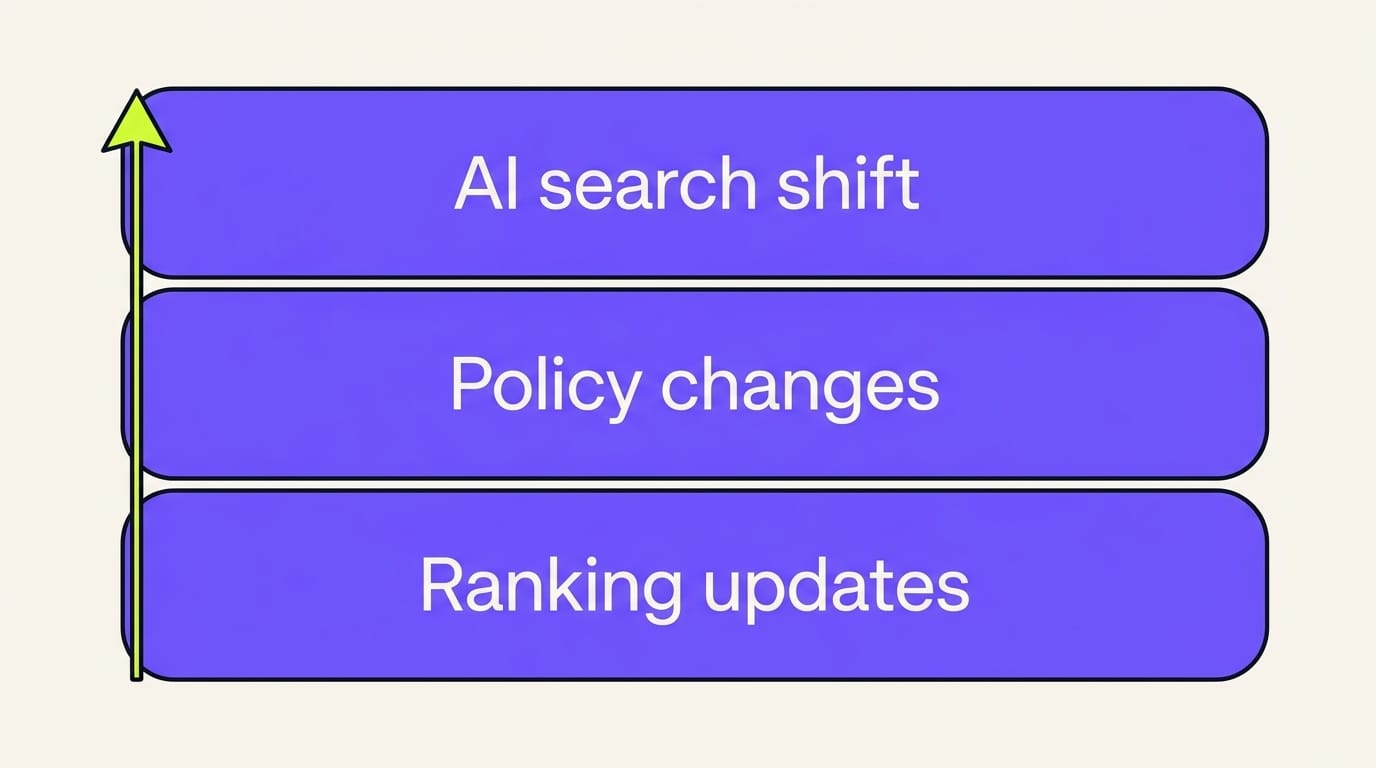
Ranking updates get the headlines. In 2026, the policy and documentation changes are where Google actually moved the rules.
AI content is still judged on quality, not on how it was made
Google's position on AI generated content did not change in 2026, and the myth that it did refuses to die, so here is the plain version. Google does not penalize content for being written by AI. Its guidance on AI generated content puts the focus "on the quality of content, rather than how content is produced."
The catch is scale. Using generative AI to mass-produce pages that add little for users can violate Google's spam policy on scaled content abuse, a policy that is deliberately method-agnostic and applies no matter how the content is created. Hand-written spam and AI-written spam are treated the same. The tool is not the problem. Publishing a thousand thin pages is.
Spam rules now explicitly cover AI answers
On May 15, 2026, Google updated its spam policy documentation to clarify that the spam policies also apply to generative AI responses in Search, meaning AI Overviews and AI Mode. This is a clarification, not a new rule, but it answers an obvious question: trying to manipulate what the AI answer says is spam, the same way manipulating a blue link result is.
The 16 named spam policies, and one quiet addition
Google's spam policy page lists 16 named policies as of its May 15, 2026 update. The four worth knowing by name are scaled content abuse (covered above), site reputation abuse, expired domain abuse, and link spam.
Site reputation abuse, often called "parasite SEO," is when a trusted site rents out its authority by publishing unrelated third-party content to rank. Google tightened this one in November 2024 so that it is a violation "regardless of whether there is first-party involvement or oversight," which closed the loophole where a publisher claimed editorial control over the parasite content. That tighter definition is still in force in 2026.
The quiet addition this year: Google folded "back button hijacking," pages that trap you when you try to return to the results, into its existing Malicious practices policy, with enforcement beginning June 15. It did not become a new category, which is why the count stayed at 16, not 17. If you see a "17 spam policies" claim, it is a miscount.
FAQ rich results are gone
Google removed FAQ rich results from Search on May 7, 2026, finishing a withdrawal that began back in 2023. The supporting tools are being retired through August 2026. This does not make FAQ schema worthless. It means the goal changed from winning a search feature to feeding AI extraction, which we work through in FAQPage schema in 2026.
The real 2026 story: AI Overviews and AI Mode
If you only track core updates, you will miss the actual change to your traffic. The biggest shift in Google Search in 2026 happened above the ranking layer, in the AI answer panel sitting on top of it.
At Google I/O in May, Google made Gemini 3.5 Flash the default model in AI Mode globally and said it is merging AI Overviews and AI Mode into a single AI Search experience. The numbers it put on stage are large. By Google's own count, AI Mode has passed one billion monthly users, with queries more than doubling every quarter since launch, and AI Overviews now reach 2.5 billion monthly users. These are company-reported figures, not audited, and some of that billion is people landing in AI Mode by default rather than choosing it. Even discounted heavily, the direction is unmistakable.
What this does to clicks is the part that should change your strategy. AI Overviews now appear on more than 20% of all searches by conservative estimates, and higher in commercial categories depending on whose tracker you trust. When an AI Overview is present, Ahrefs found that the top ranking organic result sees roughly 58% lower click-through, based on a study of 300,000 keywords. Read that carefully, because it gets misquoted constantly: the 58% drop is for the number one result specifically, not an average across the whole page.
Zoom out and the trend is the same. SparkToro's 2026 analysis found that about 68% of US Google searches now end without a click, up from roughly 60% two years earlier. The two figures come from different data providers, so treat it as a direction rather than a precise jump, but the direction is clear: more answers on the results page, fewer visits to your site. And because Google still holds roughly 90% of global search (90.39% in May 2026, by StatCounter's count), this is not a niche problem you can wait out.
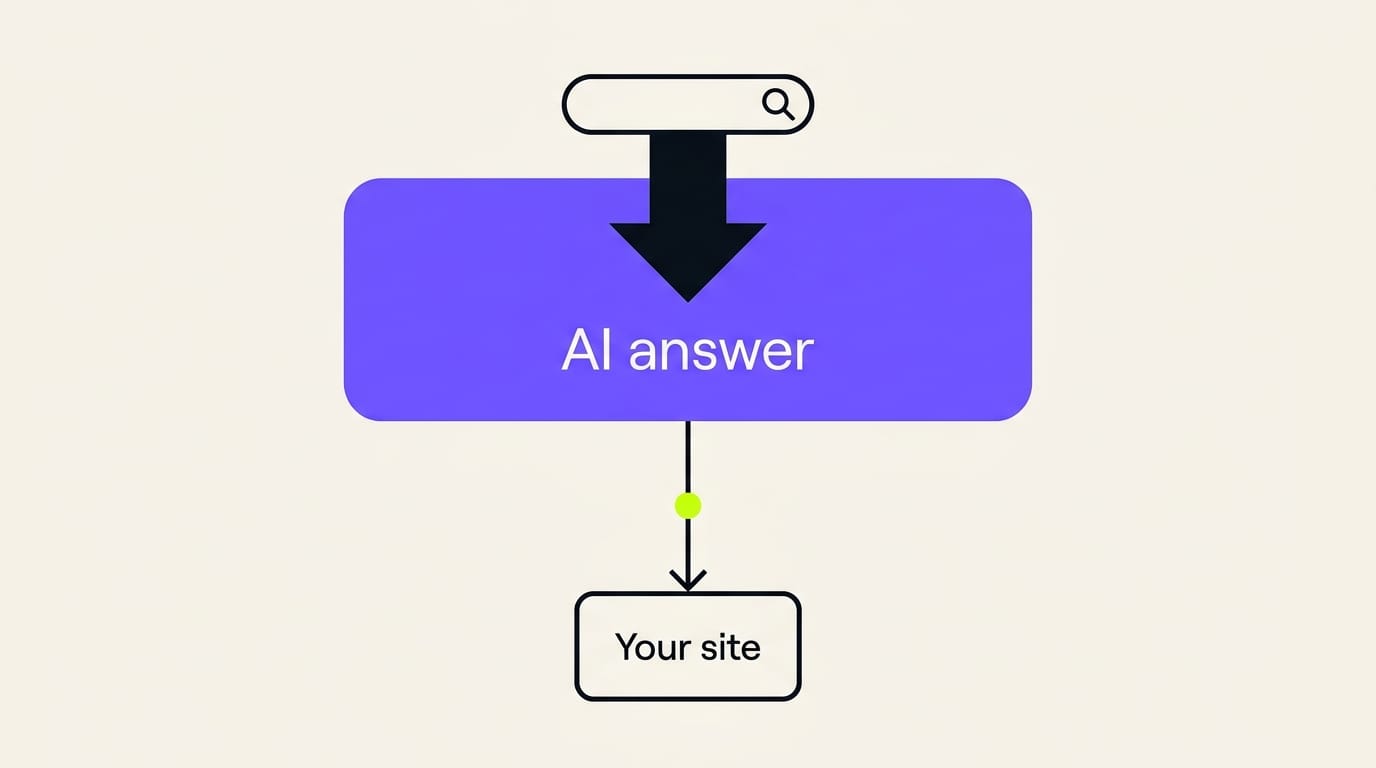
The practical conclusion is uncomfortable but simple. Ranking number one is worth less than it was, and being the source the AI answer cites is worth more. That is a different skill from classic SEO, and it is the whole reason we argue that citation is the new position one. For the tactical version, how to actually get cited in an AI Overview is the playbook.
What did not change in 2026 (and the myths to drop)
A good update tracker also tells you what to ignore. Three things people will swear changed this year did not.
E-E-A-T is still not a ranking signal. Experience, Expertise, Authoritativeness, and Trustworthiness is a mnemonic from Google's Search Quality Rater Guidelines, used by the human raters who evaluate the search system rather than scored by the algorithm and stamped on your page. No 2026 update changed that. The full argument, in Google's own words, is in E-E-A-T isn't a ranking signal.
Core Web Vitals thresholds did not move. The "good" thresholds are still Largest Contentful Paint within 2.5 seconds, Interaction to Next Paint under 200 milliseconds, and Cumulative Layout Shift under 0.1, exactly as before. INP replaced the old First Input Delay metric back in March 2024, so if your notes still say FID, they are out of date. And the claim making the rounds that Google tightened LCP to 2.0 seconds in 2026 is false. The official threshold on Google's Core Web Vitals documentation is still 2.5 seconds. We cover what actually moves the score in Core Web Vitals in 2026.
Links still count, and link spam is still against the rules. No update "killed backlinks." Link spam remains one of the 16 named spam policies. Buying links to manipulate rankings was a violation in 2025, and it is a violation now.
One thing is gone: the standalone Helpful Content System. Google folded it into the core ranking systems in March 2024, so there is no separate "helpful content update" coming. When people wait for the next one, they are waiting for a release that no longer exists.
What to actually do about it
Generic advice like "write helpful content" is true and useless. Here is the specific version, tied to what actually happened this year.
- Check the dashboard yourself. Bookmark the Search Status Dashboard and read it directly, because going to the source already put you ahead of most published roundups on what 2026 actually shipped.
- Diagnose drops by date, then by type. If you lost rankings in late March, separate the spam update (March 24 to 25) from the core update (March 27 to April 8). A spam hit means a policy fix; a core hit means a relevance problem with no quick switch.
- Audit against the spam policies, not against vibes. If you publish at volume, read the scaled content abuse policy honestly. If you host sponsored or third-party posts, read site reputation abuse. Those are the enforcement edges Google is actively working.
- Assume your money queries have an AI Overview. Search each one, and where an AI answer sits on top, optimize the page to be quotable with clear, self-contained answers rather than only to rank. Start with how to get cited in an AI Overview.
- Hold Core Web Vitals at the real numbers of 2.5 seconds, 200 milliseconds, and 0.1, and do not let anyone talk you into chasing a fake 2.0 second target that Google never set.
- Stop optimizing FAQ schema for a feature that no longer exists. Keep the schema if it is honest, but the payoff now is AI extraction, not a search feature.
Where this leaves you
The algorithm updates of 2026 were ordinary: three of them, all logged, all survivable with the same fundamentals Google has published for years. If you came here worried that Google rewrote the rulebook this spring, it did not.
What changed is the shape of the results page. AI now answers a growing share of searches and sends fewer of them onward, and Google's own conference numbers say that is accelerating, not leveling off. Track the updates so you can diagnose a drop with real dates instead of guesses. Then spend your effort on the harder, more durable goal: being the source the answer is built from. That is where Google is taking search, and for once, it is saying so out loud.
Sources
- Google Search Status Dashboard (the primary record of confirmed ranking updates and their durations)
- Google releases the March 2026 spam update (Search Engine Land)
- March 2026 core update rollout is complete (Search Engine Land)
- May 2026 core update rollout is complete (Search Engine Land)
- Google's guidance on AI generated content (Google Search Central)
- Google Search spam policies (Google Search Central)
- Google Search Central updates changelog (Google Search Central)
- What to know about site reputation abuse (Google Search Central)
- Core Web Vitals (Google Search Central)
- AI in Search at Google I/O 2026 (Google)
- AI Overviews reduce clicks (Ahrefs)
- In 2026, less than one third of Google searches send a click (SparkToro)
- Search engine market share worldwide (StatCounter Global Stats)