

WordPress bloat is killing your AI search visibility. Enterprise WordPress sites running 30-60 plugins generate 4-8 second load times, 500KB-2MB of render-blocking JavaScript, and 3,000-10,000+ DOM nodes per page, which creates heavy friction for AI crawlers from ChatGPT, Gemini, and Perplexity. AI-native headless architecture strips that bloat out, delivering sub-200ms server responses and clean semantic HTML that AI can parse without friction.
| Metric | WordPress (30-60 plugins) | AI-Native Headless Architecture |
|---|---|---|
| TTFB (Time to First Byte) | 800ms - 2s | Sub-200ms |
| JavaScript payload | 500KB - 2MB | Under 100KB |
| CSS payload | 200KB - 800KB | Under 50KB |
| DOM nodes per page | 3,000 - 10,000+ | Under 500 |
| Plugin attack surface | 30-60 plugins | Zero plugins |
| AI crawler readability | Obfuscated by page builders | Clean semantic HTML |
| Schema markup | Plugin-generated, often broken | Baked into codebase |
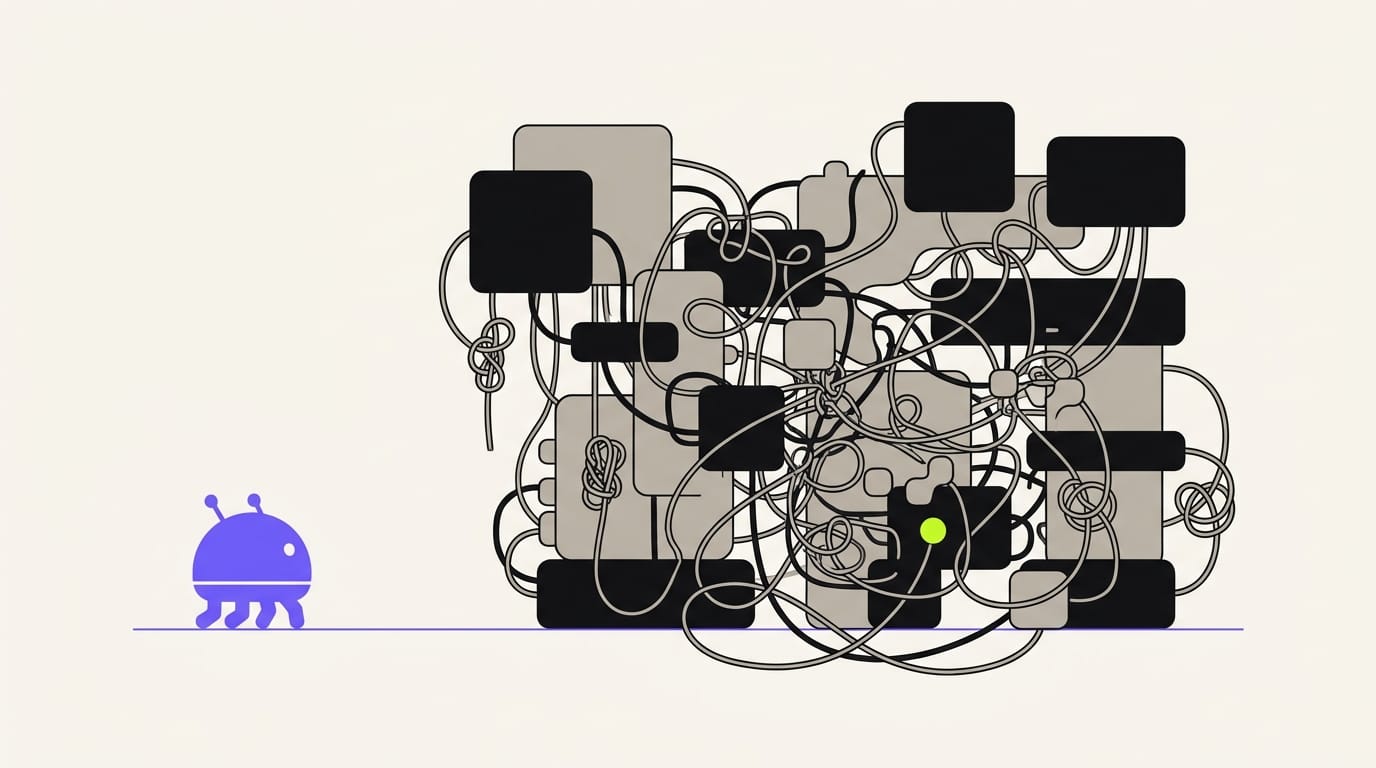
The WordPress Problem No One Talks About
WordPress powers roughly 40% of the internet. It is also the single largest source of technical debt in B2B digital infrastructure.
The typical enterprise WordPress site runs 30-60 active plugins, each one injecting its own JavaScript and CSS and database queries. The result loads in 4-8 seconds, fires off hundreds of render-blocking requests, and hands AI crawlers a wall of obfuscated code that barely resembles the content the business actually wants to communicate.
Treat that as an existential threat to your AI visibility, not a minor performance gripe.
What Is Crawl Budget and Why Does It Matter?
Crawl budget is defined as the finite number of pages a search engine or AI crawler will allocate to indexing your website within a given timeframe. Every website has a crawl budget, and it is not unlimited.
When your site is bloated with plugin-generated pages, long redirect chains, and slow server responses (often with duplicate content layered on top), crawlers spend that budget on junk. Your most important pages, the service offerings and the case studies and the thought leadership, may never get indexed at all.
For AI crawlers the problem compounds. LLMs doing real-time retrieval need to parse your content fast and pull structured meaning out of it. A WordPress site with 47 plugins, inline styles everywhere, and content that only appears after JavaScript runs is the digital equivalent of reading a book through frosted glass.
The Technical Teardown
Here is what a typical WordPress agency build looks like under the hood:
Server Response: 800ms to 2s TTFB (Time to First Byte), the combined cost of PHP rendering and database queries on unoptimized hosting.
JavaScript Payload: 500KB-2MB of JavaScript from plugins like Elementor and WPBakery and Yoast and WooCommerce, plus dozens of ancillary scripts. Most of it is render-blocking, so the browser, and the AI crawler with it, must download and execute the whole thing before any content appears.
CSS Bloat: 200KB-800KB of CSS, much of it unused. Page builders generate thousands of utility classes and load them on every page whether the page touches them or not.
DOM Complexity: 3,000-10,000+ DOM nodes per page. AI crawlers have to traverse that whole tree to find the actual content, which usually sits buried under layers of wrapper divs and shortcode output and plugin markup.
Plugin Conflicts: Every plugin update is a potential breaking change, and security holes in outdated plugins are the number one attack vector for WordPress sites.
The AI-Native Alternative
AI-native architecture is defined as a digital infrastructure built from the ground up for machine readability and semantic clarity, with zero technical friction in the way.
At Space & Story, our builds use:
- Headless frameworks (React-based) that generate clean, semantic HTML with minimal JavaScript overhead
- Static generation and edge rendering that deliver sub-200ms TTFB globally
- Zero plugin dependencies, since every feature is custom-engineered, which removes both the bloat and the security holes
- Semantic HTML5 structure with a proper heading hierarchy and ARIA attributes, with schema markup baked into the codebase
- Cite-met hosting, our proprietary deployment environment tuned specifically for AI crawler performance
Cite-met is defined as Space & Story's proprietary hosting and deployment infrastructure, engineered to deliver zero-friction indexing for both traditional search engines and AI platforms.
The Replatforming Process
Replatforming does not mean rebuilding everything from scratch. Our migration process is systematic:
- Audit: We run our AEO Matrix Scanner to surface every technical liability on your current site, from bloated assets and broken schemas to crawl waste and missing entity relationships.
- Content Architecture: We map your existing content into a semantic entity framework, ensuring every page serves a clear purpose in both human navigation and AI comprehension.
- Build: We engineer the new infrastructure using our headless stack, migrating content programmatically and implementing proper redirects to preserve existing authority.
- Launch & Monitor: We deploy to Cite-met infrastructure and monitor AI citation performance across ChatGPT, Gemini, and Google AI Overviews.
The whole process runs through GiveFeedback.dev, our award-winning collaboration platform that kills the email chain and lets clients leave feedback in real time directly on the staging site.
The Cost of Inaction
Every month your brand runs on bloated infrastructure is a month your competitors spend building AI authority, and that gap compounds. AI models learn which sources to trust, so once a competitor is the cited authority in your vertical, displacing them takes far more effort than it would have taken to get there first.
Replatforming is a structural investment in your brand's long-term digital equity, not a fresh coat of paint over the same foundation.
Not sure how much your current stack is costing you in AI visibility? The free audit measures your load time and schema coverage and how cleanly a crawler can read you, and the services and pricing page lays out what a headless rebuild runs at each tier.