
Google Analytics tells you that 412 people visited last week and 68 percent of them bounced. Website visitor identification tells you that three of them were Bloor West Dental Group, Beaverbrook Builders, and a law firm in Ottawa, and that the dental group read your pricing page twice. Those are not competing tools. They answer two different questions, and most businesses only have the first answer.
We run both for clients, alongside cite-met.com for AI-traffic tracking, so this is the practical comparison: what each one is genuinely good at, where each one goes blind, and why the honest answer is that you want them side by side rather than one instead of the other.
What Google Analytics is actually for
Analytics is a behavioral measurement tool, and on its own terms it is excellent. It shows you how much traffic you get, which channels send it, which pages hold attention, and how those numbers trend over weeks and months. If you want to know whether your AEO work is growing AI-referral traffic, or whether a new landing page lowered your bounce rate, analytics is the right instrument.
What it will not do, by design, is tell you who any individual visitor was. Its entire model is anonymized and aggregate. It samples, it strips identity, and newer versions lean further into privacy-safe aggregation. That is a feature for its actual job, which is measuring patterns at scale. It is a wall when the question is "who should we follow up with."
What visitor identification is actually for
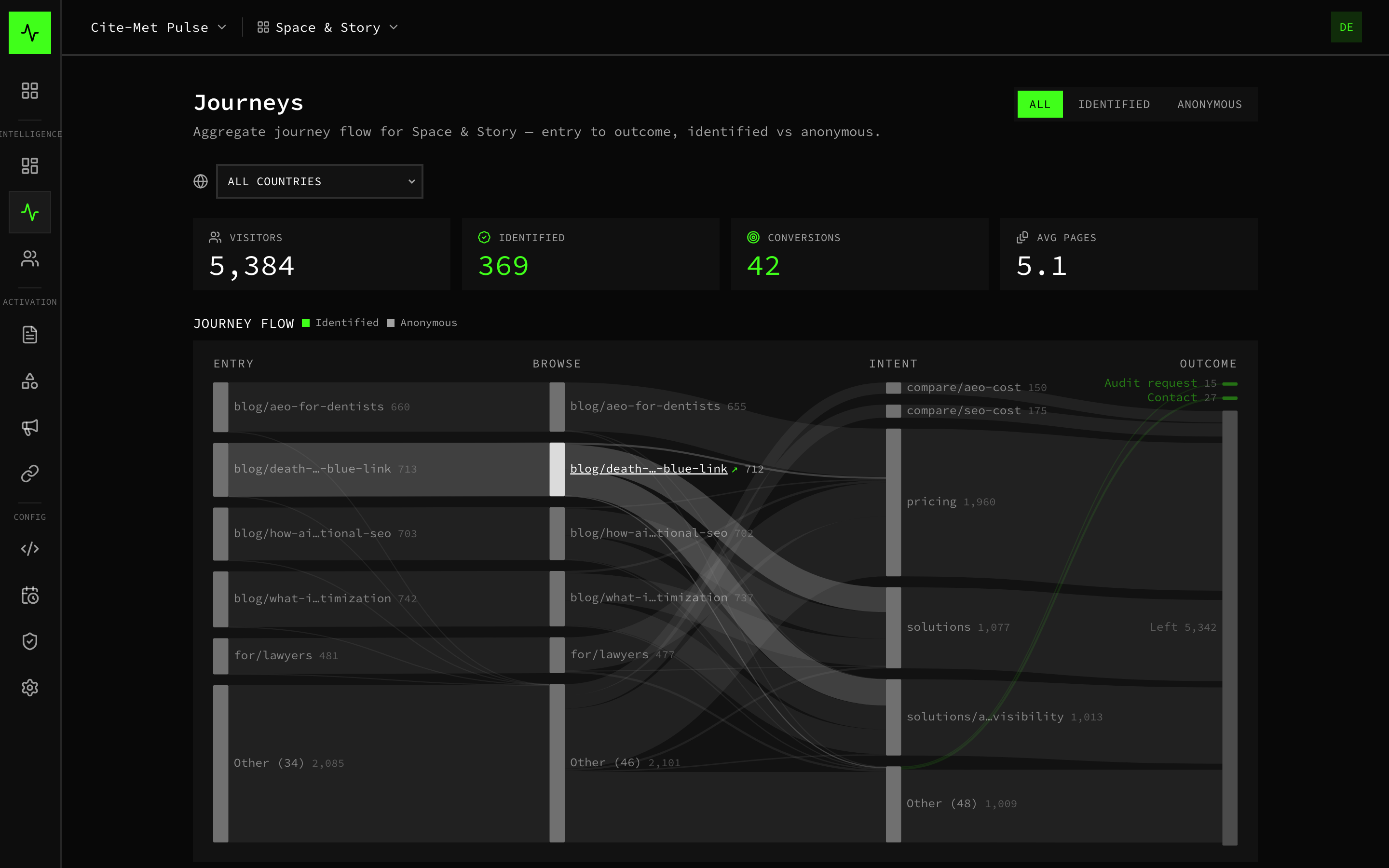
Visitor identification starts from the opposite premise. Instead of anonymizing, it resolves. It turns the corporate IP a business visitor arrives on into a company name, and it turns a form fill or a personalized-link click into a named person, then stitches every page that visitor read to that record. We covered the mechanics in how to see which companies are visiting your website.
The output is not a chart, it is a roster: named companies and people, how often they have come back, what they read, and how far toward a conversion they got. Where analytics gives you "412 sessions," identification gives you a list your sales team can work Monday morning.
The side-by-side
Held against each other, the split is clean.
| Google Analytics | Visitor identification | |
|---|---|---|
| Core question | How does my traffic behave? | Who is my traffic? |
| Shows the person or company | No, anonymized by design | Yes, company and identified person |
| Per-visitor journey | Aggregate paths only | Full page-by-page history per record |
| Captures leads | No | Yes, with forms and booking |
| Best at | Trends, channels, benchmarking | Named leads, warm outreach, capture |
| Data ownership | Held and modeled by Google | Yours, if it's self-hosted |
The row that matters most is the last one. Analytics data lives with Google and is modeled on their terms. Whether your identified-visitor data lives in your own database or on a vendor's cloud is a choice you make when you pick the tool, and it is the choice that should worry a business whose visitor list is genuinely sensitive.
Where each one fails
Analytics fails the moment the question becomes personal. "Which accounts are in-market right now" is unanswerable in Google Analytics, and no amount of custom reporting changes that, because the identity was never captured. It is the wrong tool for pipeline, and using it as one is how teams convince themselves they are "data-driven" while flying blind on their warmest leads.
Identification fails if you expect it to unmask everyone. It resolves companies on corporate networks and people who identify themselves. A consumer on a phone who reads one page and leaves stays anonymous, and honestly should. It is also the wrong tool for pure trend analysis, where analytics is cleaner and cheaper. And run carelessly, on a cloud that hoards and resells the data, it becomes a privacy liability rather than an asset. The deterministic, self-hosted, consent-aware version is the one worth running.
Why you want both
These tools are complementary, not rival. Analytics tells you the AEO work is growing your traffic and which pages carry it. Identification tells you which companies inside that traffic are worth a call and lets you capture them. One proves the channel is working; the other turns the channel into revenue.
That is exactly why we bundle identification and capture into Cite-Met Pulse and include it on the Growth and Authority plans rather than selling it as a separate line item. Analytics you already have. The layer that names the traffic and books it is the one most businesses are missing, and it is what our free audit is built to show you.
The honest summary
Google Analytics answers how your traffic behaves. Visitor identification answers who it is. Analytics anonymizes by design and is the right tool for trends and benchmarking; identification resolves companies and people and is the right tool for named leads and capture. Neither replaces the other, and the real question is whether the who-layer runs on data you own. Keep analytics for the pattern. Add identification for the pipeline.