

Answer Engine Optimization (AEO) is defined as the practice of structuring your digital infrastructure and semantic content so that AI platforms (including ChatGPT, Gemini, Perplexity, and Google AI Overviews) extract and cite your brand as the definitive, direct answer to relevant user queries.
This is the complete guide for enterprise brands that need to understand AEO, why it matters, and how to put it into practice.
Why AEO Exists
The way people find information has changed at the root. In 2024, ChatGPT passed 200 million weekly active users, Google launched AI Overviews that synthesize answers right in the results, and Perplexity established itself as a credible alternative to traditional search.
These platforms do not hand back a list of links. They return one synthesized answer, and they cite the sources they trust most to build it.
For enterprise brands that depend on digital visibility for lead generation, the question is no longer "Do we rank on page one?" It is "Does the AI cite us as the authority?"
AEO vs SEO: The Core Differences
Traditional SEO optimizes for page rankings on search engine results pages (SERPs), focusing on keywords and backlinks and domain authority alongside raw technical performance. The output is a ranked list of URLs that users click through.
AEO optimizes for AI citations instead, focusing on semantic structure, entity relationships, and explicit definitions in machine-readable content. The output is your brand being referenced as the authoritative source inside an AI-generated answer.
| Dimension | Traditional SEO | Answer Engine Optimization (AEO) |
|---|---|---|
| Goal | Rank on SERPs | Get cited in AI-generated answers |
| Content structure | Keyword phrases, search volume | Entities, explicit definitions |
| Authority signals | Backlinks, domain authority | Semantic depth, schema markup, entity coverage |
| Technical requirements | Fast loads, mobile responsive, clean URLs | All SEO requirements + semantic HTML, JSON-LD, SSR, clean DOM |
| Measurement | Rankings, organic traffic, CTR | AI citation frequency, entity coverage across platforms |
| Output | Ranked list of blue links | Brand cited as authoritative source |
Here are the key differences:
Content Structure: SEO content targets keyword phrases and is organized around search volume. AEO content is organized around entities and explicit definitions that AI can extract verbatim.
Authority Signals: SEO relies on backlinks and domain authority. AEO relies on semantic depth, entity coverage, structured data (JSON-LD schemas), and content that demonstrates expertise through specific, verifiable claims.
Technical Requirements: SEO requires fast page loads and mobile responsiveness on clean URLs. AEO requires all of that plus semantic HTML, schema markup on every page type, clean DOM structures that AI crawlers can traverse, and server-side rendering or pre-rendering for non-JavaScript crawlers.
Measurement: SEO measures keyword rankings and organic traffic and click-through rate. AEO measures AI citation frequency, entity coverage across AI platforms, and whether your brand shows up in synthesized answers for target queries.
The Five Pillars of AEO
Based on our work with enterprise clients at Space & Story, AEO success rests on five pillars:
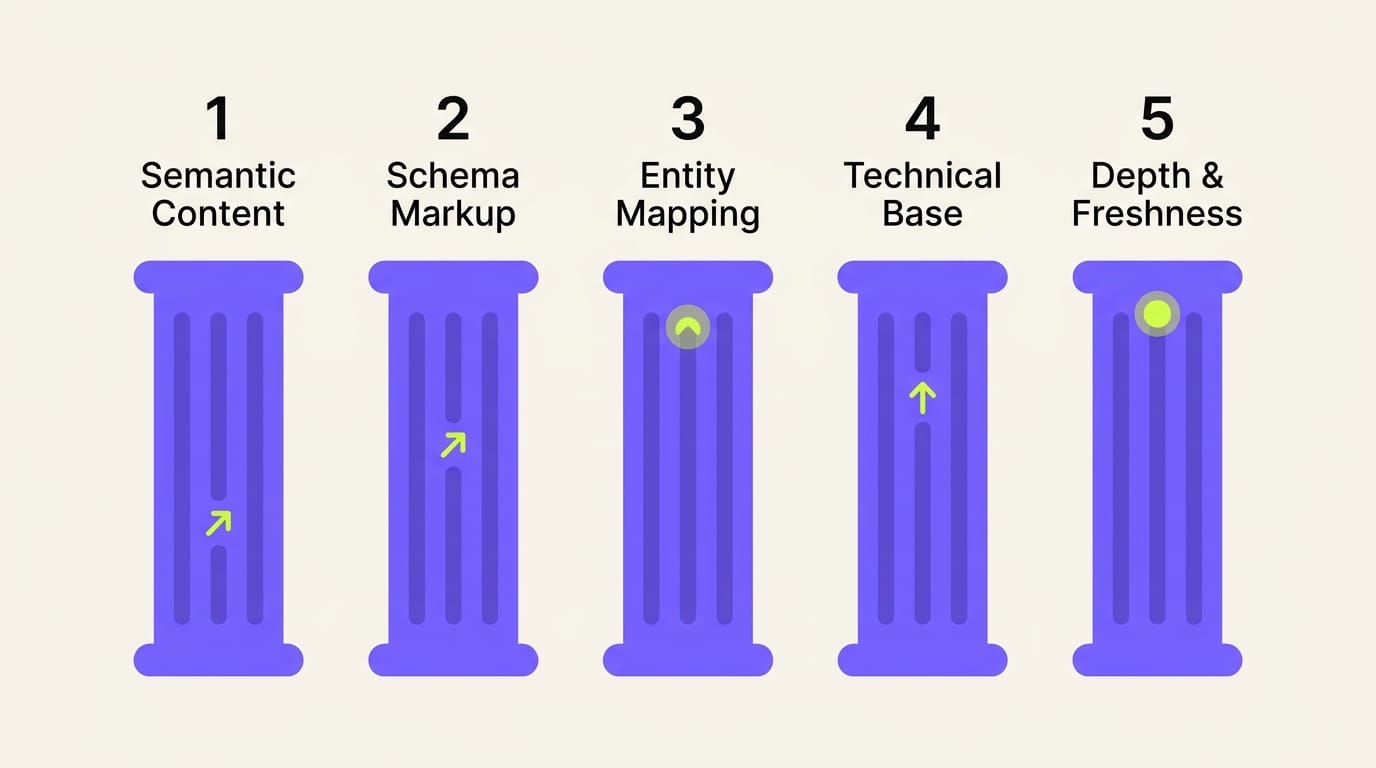
Pillar 1: Semantic Content Architecture
Every page on your site has to serve a clear semantic purpose, which means organizing content around entities (your brand, your services, your methodologies, your case studies) rather than around keywords. Define each entity explicitly, in the "AEO is defined as..." form, so AI models can lift that definition straight into a generated answer.
Pillar 2: Full Schema Markup
JSON-LD structured data is the translation layer between your human-readable content and machine-readable data. At a minimum, every page should carry ProfessionalService and BreadcrumbList plus the page-type schema that fits it, whether that is BlogPosting, FAQPage, or Service. Speakable specifications then tell AI which content is suitable for voice and citation extraction.
Pillar 3: Entity Relationship Mapping
AI models understand brands through the relationships between their entities. Your services page should link to the relevant case studies, those case studies should link to the methodologies they used, and your blog posts should define industry terms and link back to your service pages. That internal entity map is how AI learns your brand has expertise across the whole subject, not just one corner of it.
Pillar 4: Technical Infrastructure
Your site must be readable by AI crawlers without friction. This means clean HTML (not 10,000 DOM nodes of page builder bloat), server-side or pre-rendered content for non-JavaScript crawlers, fast server responses (sub-200ms TTFB), and a robots.txt that explicitly allows AI crawler access.
Pillar 5: Content Depth and Freshness
AI models favor sources that show deep expertise. That means publishing thorough guides like this one, keeping FAQ sections stocked with direct answers, updating content as the data moves, and covering adjacent topics that reinforce your authority.
How to Get Started
The first step is an audit. You need to understand where your brand currently stands in AI search. Ask ChatGPT, Gemini, and Perplexity questions your target customers would ask. Note which brands are cited and which are not. Then compare your site's semantic structure, schema coverage, and entity relationships against the brands that are being cited.
At Space & Story, we run this diagnostic through our AEO Matrix Scanner, which maps your current entity coverage and identifies exactly where competitors are being cited while you are not.
The brands that invest in AEO now compound their AI authority. The ones that wait will find it far harder to displace the cited sources that got there first.
AEO is the present of search, not its future. The only open question is whether your digital infrastructure is built for it.
If you want to see how your own site scores on the AEO factors above, start with the free AEO audit. It reports where AI engines can and cannot read you today, and the solutions page shows what a fix looks like at each tier.